It occurred to me that some of the most sophisticated and gourmet food started out as simple what was available to use food.
What got me to thinking about this was my recent adventures in the old school Roman pasta dishes.
Listed here are the main four great Roman pasta dishes. Pasta, guanciale, and pecorino are the veins that pulse through each one of these quintessentially Roman dishes. Pasta alla Gricia, Cacio e Pepe, Carbonara, and Amatriciana, each play off of the others and reveal different sides of the same basic concept.
Gricia is simple and focused on the luscious guanciale fat with a dusting of pecorino, while cacio e pepe has no meat just a bit more cheese and pepper for a rich sauce, a very robust Mac and cheese vibe. Add an egg and keep the meat and you have indulgent carbonara. Tomatoes, no egg for hearty amatriciana, more like what most Americans view what an extremely good spaghetti sauce to be like.
Every one of these dishes has no butter or cream added to come up with the creaminess of the sauce. It is all done with the starchy pasta water and cheese. These four examples of Italian, cuisine of what a few simple ingredients can mean. And to think all these years I have been draining all my pasta water down the drain!
French gourmet cookery is based on the same simple concept for using ingredients that are available and at one time cheap.
Escargot (ɛs.kaʁ.ɡo) is the French word for snail. It has over the years become synonymous with expensive gourmet dining. It is a dish consisting of cooked land snails. Often it is served as an hors d’oeuvre and is common in France and India (particularly among the Naga people). Escargot is part of the typical cuisines of Cyprus, Malta, Crete, areas of mainland Greece, as well as the North African countries Tunisia, Algeria, and Morocco. Escargot is consumed in Germany, Great Britain, Italy, Portugal, and Spain
While not all species of land snail are edible, and many are too small to be worth preparing and cooking. Among the edible species, the palatability of the flesh varies.
In France, the species eaten most often is Helix pomatia. The “petit-gris” Cornu aspersa and Helix lucorum are also eaten. Several additional species, such as Elona quimperiana, are popular in Europe.
Apple snails (Ampullariidae) are also consumed in Asia and can be found in Asian markets in North America. Nutritional analysis shows that Ampullariidae are a nutritious and a good source of protein.
Snail shells have been found in archaeological excavations, indicating snails have been eaten since prehistoric times. Archaeological sites around the Mediterranean have yielded physical evidence of culinary use of different species of snails.
The Romans also considered escargots an elite food. The edible species Otala lactea has been recovered from Morocco in the Roman-era city ruins of Volubilis.
Even more recently, African land snails have been found to be edible.
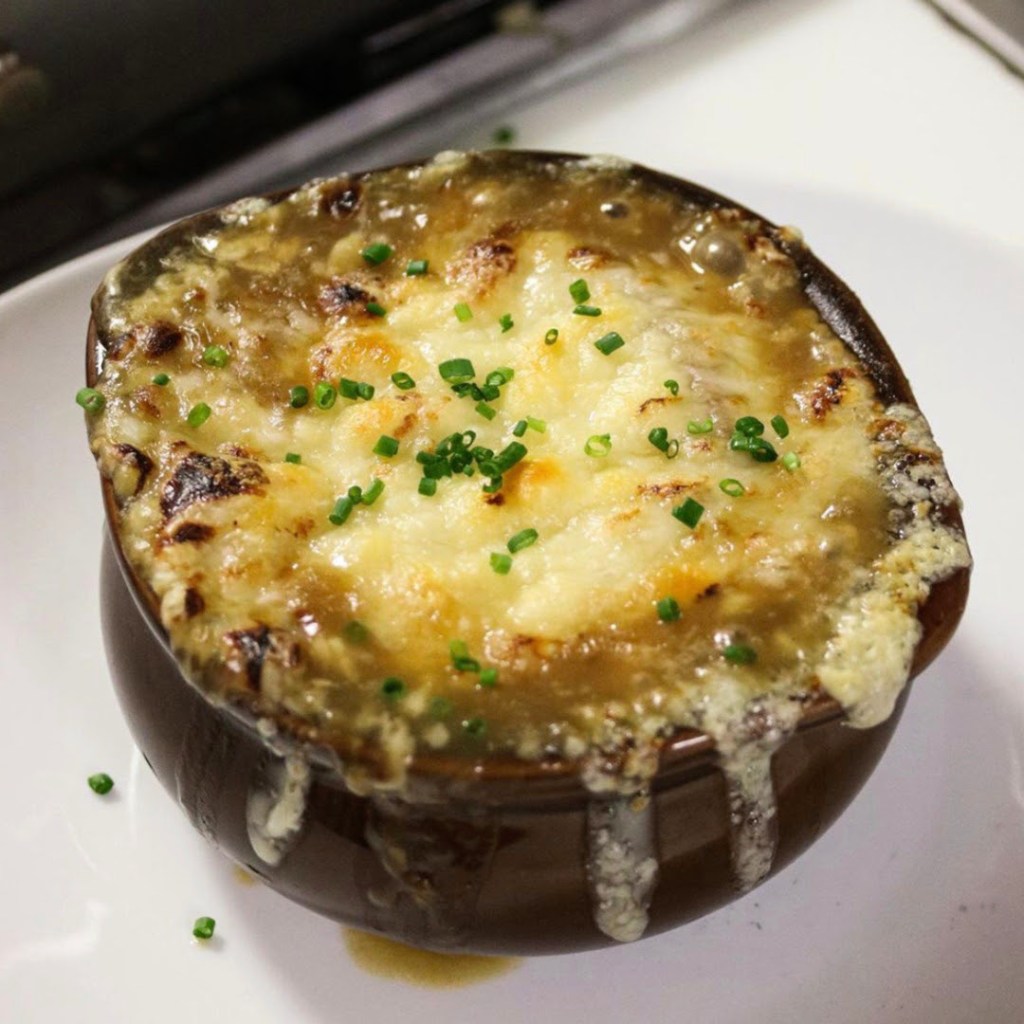
Onion soups have been popular at least as far back as Roman times. Throughout history, they were seen as food for poor people, as onions were plentiful and easy to grow. The modern version of this soup originates in Paris, France in the 18th century. It was made from beef broth, and caramelized onions.
It was introduced to the United States by the New York restaurant of Henri Mouquin in 1861, where his wife Marie Julie Grandjean Mouquin was the chef. It is often finished by being placed under the broiler in a ramekin with croutons and cheese melted on top.
Cajun cuisine is considered simpler ‘country food’, and is based on Acadian cuisine whereas Seafood also plays a prominent part in the dishes. Cajuns are descendants of Acadians who were deported to Louisiana. It’s also believed that Acadians are responsible for normalizing potato consumption in France—a vegetable the French once considered poisonous.
Acadian cuisine has notably served as the base for Cajun cuisine because the Acadian cuisine has been influenced by many things throughout its history, namely the Deportation of the Acadians, proximity to the ocean, the Canadian winter, soil fertility, the Cuisine of Quebec, Native Americans, American cuisine and English cuisine.
The cuisine of immigrants and trading with specific regions of the world have also played small roles. French colonists who settled Acadia in the 17th century adapted their 16th-century French cuisine to incorporate the crops, seafood and animals that flourished in the region. Basically, what was available.
Their descendants became the Acadian people and their ingenuity created Acadian cuisine or as we know it Cajun.
In this blog I touched on basically three of what I would consider the most marvelous dishes and cuisines from the humblest of histories. I know there are more out there, but these will do for now.
 Fearless Cooking on a Fixed Income!