Are you one of those cooks that throw away all of their meat scraps? What I am talking about are bones, chicken, beef and pork. Shrimp and lobster outer shells and heads. Finned fish heads and bones. And don’t forget the meat drippings left after cooking certain dishes!
All of the aforementioned are types of jus, which is cooking gold when it come to flavor.
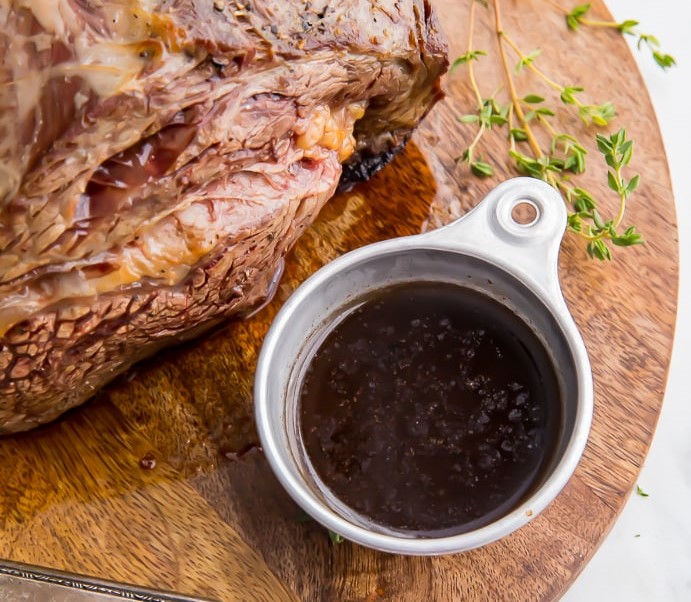
Jus (pronounced ‘zhoo’) is a natural by-product, the literal ‘juice’ that comes off cooking meat. Some call it the ‘pan drippings’. Others call it the ‘purge’ but I don’t like the name as it produces a negative picture in my mind. Especially for something that is packed with the flavor and essence of the meat itself!
Au jus is a term that means cooking (or serving a dish) with the juice of the meat. For example, a French Dip sandwich served au jus is typically a sliced beef sandwich served with a side of the meat juices that came off the beef as it cooked, along with a dash of butter, flour, and red wine.
Don’t trust any recipe that claims you can serve au jus without the pan drippings! You can also purchase pre-made jus from the store, but it’s a pale imitation. The best jus comes naturally off of a meat dish as it’s cooking, so long as it’s over a moist form of heat (say, braising instead of grilling).
Sometimes the process yields interesting results! The other day after making a batch of beer-braised pulled pork, I poured the results through a fat separator and into a clean mason jar. After letting the mixture sit for a few minutes, this is what I got, which is rather pretty. The thin gold layer at the top is the remaining fat. In the middle is a dark layer of liquid pork stock. At the bottom are a mix of very fine particles including the spices, and other bits of pork goodness.
This whole jar is pure flavor. After being placed in the fridge or frozen it will be in a soup, gravy, sauce, or a dozen other applications.

Pan drippings after frying or searing a protein can and should be used to make gravies or sauces.
With roux made from flour or cornstarch in the pan. Flour for gravies and cornstarch for sauces. Cornstarch gives a glossier sheen for your sauces, Flour provides a denser, more substantial product. I usually mix my thickener with water before pouring into the drippings that way it insures it to be lump free.
A handy hint to make a roux in advance to use in the darker gravies; bake flour in a 400 degree oven until it is a golden brown. You will need to watch it and stir it often to ensure that it doesn’t burn. When it is the golden-brown color take it out and let it cool the put in an air tight container for use later. It will enhance the brownness of the darker gravies or demiglace.
 Fearless Cooking on a Fixed Income!